There's a moment in every producer's life when the tools stop serving the music and start getting in the way. You're chasing a sound — you can hear it clearly in your head — but no plugin, no preset, no patch does quite what you need. You spend three hours tweaking and layering, and still it's not right. So you either settle, or you build.
We built. Four plugins, two years, one label.
A Label Born from the Floor
Ill Bomb Records has been operating in the underground since the beginning. We didn't start as a business — we started as a crew of people who couldn't stop making music and needed somewhere to put it. The releases came first. Then the artists. Then the infrastructure. Then, eventually, the software.
Every catalogue entry we've released has been shaped by the same obsession: how does this feel on a dancefloor? Not just in headphones. Not just in a listening session. Does it move people? Does the kick land right? Is there enough tension in the breakdown to make the drop feel like a release?
That question drove years of releases across techno, electro, and everything in between. It also drove us deep into the technical side of production — into the signal chain, the synthesis, the sequencing. Into the code.
"We're not a software company. We're a record label that got too deep into code. The difference is, everything we built, we built because we genuinely needed it in the studio."
Bomb Synth
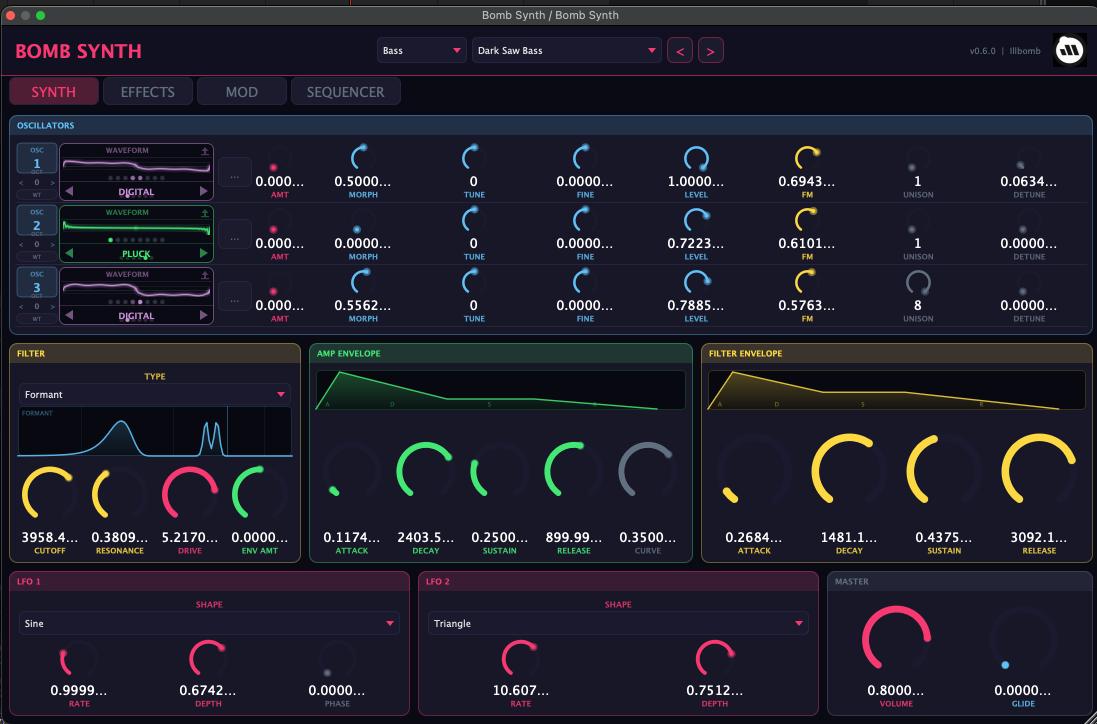
The Bomb Synth is where things get deep. It's a hybrid synthesizer combining three oscillator engines — wavetable, granular, and analog-modeled — with a built-in step sequencer, a full modulation matrix, effects chain, and per-oscillator controls that let you sculpt sound at a level most soft synths don't allow.
The synthesis architecture was designed around one question: how do you make a synth that sounds alive? The answer was layering. Three oscillators, each independently selectable from nine engine types: Wavetable, Granular, Sine, Saw, SuperSaw (7-voice unison), Square with pulse width, Triangle, SawTri blend, and Noise.
On top of the oscillators: a filter section with six modes (Ladder LP/HP, State Variable, Formant, Comb), an 8-slot modulation matrix with LFO, Velocity, and Mod Wheel sources routing to 24 targets, spectral warp (Phase Bend, Smear, Mirror), and a full effects chain with reverb, delay, and drive.
The built-in step sequencer runs per-lane arpeggiators with seven modes, step-level probability and velocity, and scale-aware randomization. Over 35 wavetable banks come included — among them the full Echo Sound Works collection, 379 individual waveforms across analog, digital, vocal, spectral, FM, and more. Load your own WAVs by dropping folders into the library path.
Bomb Sequence Generator
The Bomb Sequence Generator is a dedicated MIDI sequencer VST built for rhythmic complexity. Where most sequencers think in straight grids, this one thinks in probabilities, polyrhythms, and patterns that evolve over time.
Each lane runs its own independent arpeggiator with seven modes — Up, Down, UpDown, Random, AsPlayed, Converge, and Diverge — at its own rate division. Set one lane to 16th notes at Converge mode, another at 32nds with Random, and let the sequence develop in ways that no static pattern could.
The Randomize function generates scale-aware patterns with accent bias, velocity curves, ghost note probabilities, and microtiming humanisation — so the output sounds played, not programmed. Lock any lane to freeze it while randomizing the rest. When you hit something you love, MIDI Export drops it directly into your DAW timeline.
"The best techno sequences feel like they're thinking. They surprise you, but they don't lose you. That's what we built toward."
BombFX
BombFX is our multi-effects processor — the one that started it all. Four independent effects (Reverb, Delay, Chorus, Filter) with individual mix faders, a chrome-and-purple UI that looks like it belongs in a hardware rack, and 27 factory presets organized by category.
It's the simplest of the four plugins in concept, but it's the one we reach for first when a track needs glue or atmosphere. The parallel routing keeps each effect isolated — push the reverb without smearing the delay, blend the chorus without killing the transients. CPU-efficient and straightforward, it solves the problem it was built to solve.
BombSeq
BombSeq is our original 64-step MIDI sequencer, built before the Bomb Sequence Generator and still very much in use. Where the newer plugin focuses on probability and evolution, BombSeq is about precision — vintage MPC60 aesthetic, rubber pad interface, amber LCD displays, and a sequencer workflow that feels like working with hardware.
Per-step Note, Velocity, Gate, and Probability parameters. MPC-style swing from 50–100%. Sixteen runtime pattern banks plus eight persistent save slots. Sample-accurate timing synced to your DAW transport. It's the workhorse — less experimental than the Bomb Sequence Generator, more immediate, just as essential.
Why Free?
All four plugins are free to download. No subscription, no license key, no lite version with features locked behind a paywall.
The reasoning is simple: we made these for ourselves, and the underground gave us everything we know about making music. Putting them behind a price tag felt wrong. We'd rather have producers using them, making music with them, telling us what's broken and what's missing.
There will be updates. There will be new features. There will eventually be premium content — wavetable expansions, sample packs built specifically for these tools. But the core plugins stay free. If they've been useful to you, there's a donate button on each download page. We appreciate it more than we can say.
What Comes Next
All four plugins are already in use across upcoming Ill Bomb releases. What you hear on the next records from the label was made, at least in part, with these tools.
Upcoming development includes new wavetable banks from our own sound design sessions, expanded sequencer modes in the Bomb Sequence Generator, and a third synthesizer we're not quite ready to talk about yet.
The music comes first. It always will. But sometimes the music needs new tools — and when it does, we build them ourselves.
— Ill Bomb Records, March 2026